
Old Way vs. New Way: Why Agentic Delivery Is the Real Leap Forward
You know that moment when you try to explain "AI delivery" to someone and they nod - but you can tell they're picturing a prompt window?
Yeah. That's the problem.
For most teams today, building with AI still means this: open Claude or ChatGPT, paste a Jira ticket, and pray the output compiles.
That's not agentic delivery. That's wishful automation.
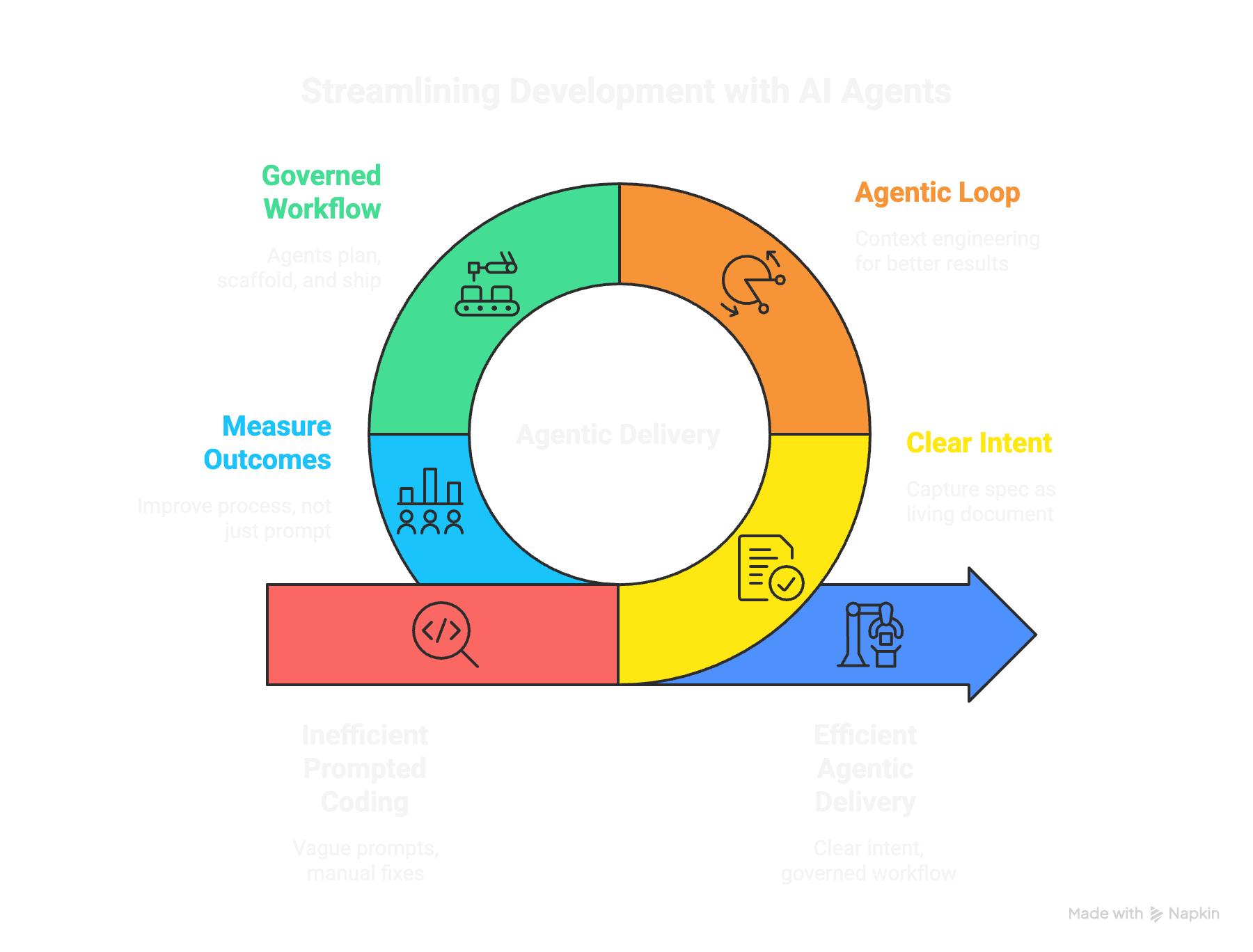
The Old Way: Prompted Coding
You've got a task: "Add authentication to the dashboard."
So you:
- Write a long prompt full of context you barely have time to check.
- Wait for the model to hallucinate its best guess at your stack.
- Copy the output into your repo, fix half the bugs by hand.
- Realize the spec was incomplete. Rewrite. Retry. Repeat.
Sure, it's faster than typing everything yourself… but it's also brittle.
Every output depends on the quality of the prompt and the memory of whoever wrote it. There's no feedback loop. No governance. No way to tell if the model actually learned anything from the last build.
That's not engineering - that's prompt babysitting.
The New Way: Agentic Delivery
Agentic delivery flips the script.
Instead of treating AI like a tool you poke with a stick, you design a loop that lets humans and agents build together - safely, repeatably, and fast.
Here's what it looks like in practice:
- Start with a living spec - the single source of truth that defines intent, context, and acceptance.
- Feed that spec into a context engine, not a chat box.
- Let agents plan → scaffold → implement → test inside a governed workflow.
- Add human-in-the-loop gates for review, approval, and trust calibration.
- Capture receipts at every step: who approved what, what changed, and why.
- Measure outcomes, not tokens - improving the process, not just the prompt.
This is how the agentic SDLC works inside OutcomeOS™.
Specs aren't throwaway documents anymore - they're executable contracts between humans and agents. Every improvement compounds. Every workflow gets smarter.
Agentic Delivery > Prompted Coding.
It's not about writing better prompts - it's about building better loops.
Why It Matters
When you stop thinking in outputs and start thinking in loops, everything changes.
- Developers move from "fixing model mistakes" to "designing feedback systems."
- Product managers stop chasing perfect tickets and start improving governance.
- The organization learns - literally - how to turn decisions into durable, auditable outcomes.
And the best part?
You're no longer shipping code that only works once. You're building a system that keeps getting better every time it runs.
TL;DR: How to Build with AI Agents
Agentic Delivery > Prompted Coding
Related Reading
- The Agentic SDLC: Turning AI from Tools into Teammates
- Spec Debt: The Costliest New Tech Debt in the Age of AI Agents
- OutcomeOS: Our Agentic Operating System for Building AI-Native Companies
BlueFolders We build AI-native companies, born to scale and born to endure. bluefolders.ai